A Baseline Approach for AutoImplant
A coarse-to-fine framework for high-resolution cranial implant generation in the MICCAI 2020 Cranial Implant Design Challenge.
Multimodal Learning for Clinical Decision Support and Clinical Image-Based Procedures, Springer, 2020
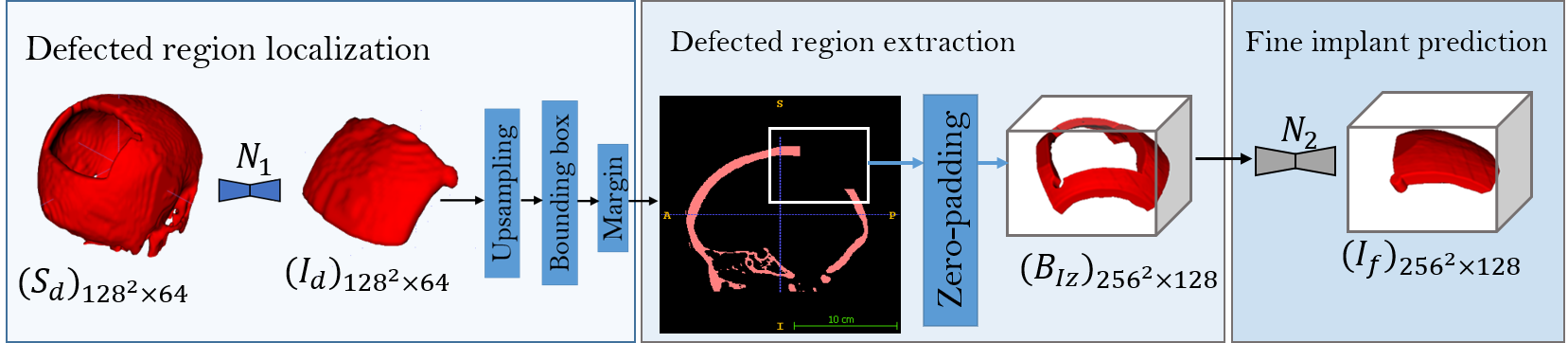
Direct implant prediction in two stages.
In this study, we present a baseline approach for AutoImplant, the cranial implant design challenge, which can be formulated as a volumetric shape learning task. The defective skull, complete skull, and cranial implant are represented as binary voxel grids. Our baseline approach predicts implants directly from defective skulls. First, an encoder-decoder network learns a coarse representation from downsampled skulls and uses it to locate the bounded defect region in the original high-resolution skull. Second, another encoder-decoder network generates a fine implant from the bounded area.
Conference presentation.
Cite this work.
@inproceedings{li2020baseline,
  title = {A Baseline Approach for AutoImplant: The MICCAI 2020 Cranial Implant Design Challenge},
  author = {Li, Jianning and Pepe, Antonio and Gsaxner, Christina and von Campe, Gord and Egger, Jan},
  booktitle = {Multimodal Learning for Clinical Decision Support and Clinical Image-Based Procedures},
  pages = {75--84},
  publisher = {Springer},
  year = {2020}
}